Service line replacement
What to Expect on Water Line Replacement Day in Orange
The pipe that carries water from the street to your house has stopped doing its job. We put you in touch with experienced main water line pros nearby who can tell you whether it needs replacing, and what that would involve on your lot.
- Calls answered 24/7
- Same-day dispatch where available
- Upfront pricing before work begins

Maybe the meter is spinning while every tap is closed. Maybe a strip of lawn near the street stays soggy in dry weather, or the pressure at every faucet has faded over a few years. Those are the usual reasons people start searching for a new water line in Orange.
Replacing the pipe is a bigger decision than patching it, so it helps to know what the job involves before anyone shows up. If the line is only damaged in one spot, a targeted repair may be all you need.
Replace the whole run, or fix one spot?
A single clean break in an otherwise sound pipe is usually a repair job. A line that has gone thin along its length, or that has already been opened up once or twice, tends to push the conversation toward replacement. The technician we dispatch looks at the evidence: where water surfaces and what the exposed pipe looks like.
Some signs lean toward replacing the line:
- Leaks that show up in more than one place along the run.
- Pressure that has been falling for years, not days.
- A past repair that has since been followed by another failure.
If the break looks isolated, read about spot repairs on a main line and ask the pro to explain which option fits.
The path a new line takes across an Orange lot
The new pipe normally starts where your side of the connection begins, near the meter or curb box, and ends at the shut-off where water enters the house. In between it crosses whatever the lot puts in the way: lawn, planter strip, walkway, driveway apron, maybe a mature tree.
The pro walks that route before quoting. Slopes, corners and where the house sits all change the length of pipe and the effort of reaching it, which is why a fair estimate comes after someone has seen the property.
Dig it up or bore under it: how the choice gets made
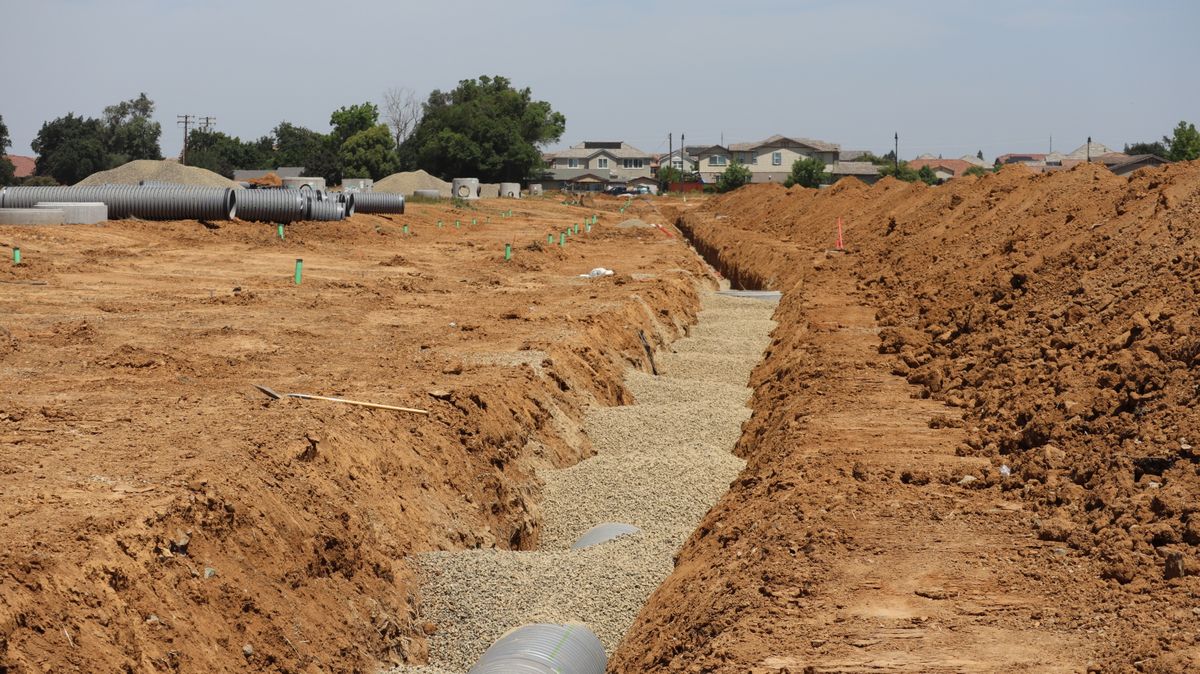
There are two broad ways to put a new line in. An open trench exposes the whole path so the old pipe can be pulled and the new one laid in its place. Trenchless methods work from a few small access points and draw or push the new pipe through the ground without opening the full route.
Neither is automatically right. Soil, other buried utilities and what sits on the surface all play a part, and the pro makes the call on site. Our page on trenchless water line replacement explains the methods and where they run into limits, so you can ask informed questions when the technician lays out the choices.
What a new service line is made of
Modern residential service lines are generally run in copper or in a flexible plastic piping made for pressurized water, and the pro will explain which is being proposed and why. The choice can depend on soil, run length and the connections at either end. Requirements vary, so the technician will advise what suits your property.
If your existing pipe is galvanized steel or something older that you cannot identify, the replacement is also a chance to move away from it. Our page on older galvanized and lead-era lines covers how a pro identifies what is in the ground now. Ask for the material and fittings to be named in the estimate.
Walking through the day of the work
The sequence is fairly consistent even though every lot differs. First the water to the house is shut off at the appropriate point. Then comes the excavation or the bore. The old line is disconnected, the new pipe is run and connected at both ends, and the crew tests it under pressure.
Only after that passes does backfilling begin, with the soil returned and compacted in stages. Surface restoration depends on what was agreed beforehand, and hardscape repair can be a separate step, so ask where the scope ends.
Your lawn, driveway and planting beds
An open trench will leave a visible scar across turf or planting beds, and a line crossing a driveway raises the question of cutting concrete. Trenchless work spares most of the surface but still needs entry and exit pits.
Before work starts, point out sprinkler heads, low-voltage lighting runs, and any tree you care about. The crew can often shift the route a little or hand-dig near roots. Do not expect a perfect lawn on day one; turf and shrubs need time to settle back in.
Why lines in Orange homes wear out when they do
Age is the main thread. In Old Towne and the older central streets, a number of homes were plumbed generations ago, and original galvanized or early copper service lines can be well into the stage where corrosion and joint trouble are common. Mid-century slab tracts carry their own aging copper and galvanized runs.
West of the freeways, Olive and Olive Heights mixes older tracts with newer infill, so neighbors can have lines of very different vintage. Out east, lines are younger but longer. In Old Towne, tight side yards and mature street trees shape the route.
Questions about replacing a main water line
Usually the pipe tells the story once a technician exposes or tests it. One break in solid pipe often points to repair. Corrosion along the run, repeated leaks, steadily declining pressure, or a patch that has already failed point toward replacement. You cannot always judge this from the surface, so describe what you have seen and let the pro inspect the line.
There is no reliable single number, and quoting one would be a guess. Service life depends on the material, the soil, water chemistry, how the line was installed and how much stress it has seen from roots or ground movement. Homes of similar age can have lines in very different condition, and the pipe in front of the technician says more than any rule.
You will be without water at some point during the work, because the line has to be shut off while it is disconnected and reconnected. How long that interruption lasts depends on the length of the run, the method, what the crew finds underground and how smoothly the pressure test goes. Ask the pro for a realistic window on your job and keep some water stored for essentials.
Property owners are usually responsible for the stretch from the meter or property line into the house, while the provider generally handles its own main and meter. The dividing point is not identical everywhere, so check with your water provider before assuming either way. The technician can also tell you if a problem looks like it sits on the provider's side.
Permit and inspection rules vary by location and by the scope of the work, and they can change, so we will not state a requirement as fact. The pro will tell you what applies to your property and explain how that is handled before work starts. In a historic district, exterior work can involve extra review, so mention it on the call.
Sometimes. Boring or pulling a pipe beneath a slab can be possible when the soil, depth and nearby utilities allow it. In other cases the concrete has to be cut and patched. The pro decides after looking at the route and any previous work under the slab. If keeping the driveway intact matters, say so when you call. Read more about going under hardscape.
Most replacement lines today use either copper or a plastic pipe rated for pressurized water, with the choice driven by the lot, the length of the run and the connection points. The technician will name the material in the estimate and explain the reason. If you have a preference, mention it early so it can be priced in, and ask which fittings will join the new pipe to your house plumbing.
Most people do, though the day is noisy and the yard becomes a work zone. Water will be off for part of it, so plan for bathroom and kitchen needs, and keep children and pets clear of open excavation. If the crew needs to reach a garage or utility closet, make sure it is accessible.
It often does when the old line was clogged with corrosion or had narrowed over time, because the new pipe carries water freely again. That is not a promise. If low pressure comes from a regulator, a partly closed valve or supply conditions on the provider's side, a new line will not change those. The pro should test and explain the likely cause before recommending the work. Our page on low pressure from the main line goes deeper.
Ask who the crew is, what method will be used and why, and what the estimate covers: excavation, materials, connections, permits if any, and surface restoration. Ask how the line will be tested, where the shut-off will be during the work, and what happens if the crew finds something unexpected underground. Confirm the pricing is explained before work starts, and ask whether a warranty on completed work applies.